Aryan Brotherhood
Inherent ViceThe Aryan Brotherhood is a prison gang whose demand that prospective members commit violence propels Glen Charlock into a dangerous bargain. Its story joins the prison world to Tariq Khalil’s outside associates and, eventually, to Glen’s work for Mickey Wolfmann. The organization is not presented through a full account of its leadership or everyday structure; instead, its importance emerges through the particular price of admission and the consequences that follow when Glen tries to meet it indirectly.
Prison Politics and Recruitment
The Brotherhood enters the narrative through Tariq’s account of a dispute among prison groups. The original conflict involved Nuestra Familia, based in Northern California, and the Sureños, from Southern California. An informant called El Huevoncito had caused trouble for prisoners across racial and gang divisions. Although inmates knew he would eventually be dealt with, the tangled history between the Chicano factions made it difficult for either side to carry out the killing. The task was therefore contracted to the Aryan Brothers.
The timing gave the Brotherhood’s role a second purpose: it was recruiting Glen, and killing someone was part of the initiation. A cut might have been enough to qualify, but it would leave Glen vulnerable to retaliation. Tariq’s account presents the Brotherhood’s expectation as a practical ultimatum within prison life: joining required a consequential act, and avoiding the act did not necessarily avoid its consequences.
Glen Charlock’s Attempt to Join
Glen wanted admission but did not want to kill anyone himself. He feared that he would make a mistake and be caught, exposing himself to retaliation by El Huevoncito’s associates or to a long confinement elsewhere in the prison system. What he wanted, sometimes desperately, was to get back outside. At the same time, the Brothers were pressing him to complete the initiation.
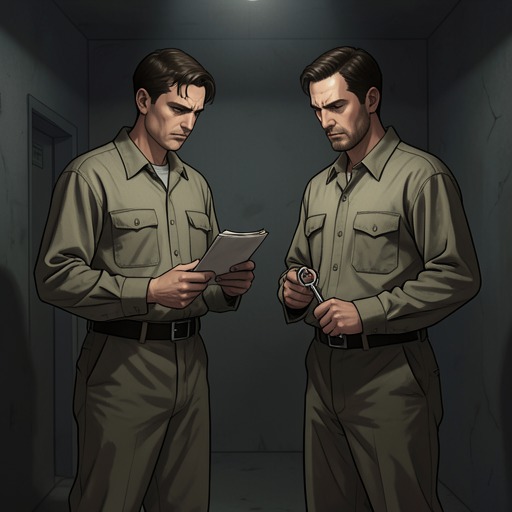
Glen’s solution was to seek a way to subcontract the killing, so he could claim credit with the Brotherhood while avoiding direct responsibility and reprisal from the informant’s allies. He approached Tariq, who had a reputation as a skilled shank artist and was known not to get caught. Their negotiation crossed a boundary that prison life enforced: Black and white prisoners did not routinely mix, and such contact was discouraged. Tariq warned that the arrangement would cost more than Glen could likely afford. Glen, however, had outside connections he had not yet disclosed, and the worsening situation made him reveal them.
The Killing and Its Aftermath
El Huevoncito was later found dead after an early-morning shake-and-bake on Tariq’s block. The circumstances gave Tariq an alibi, and the killing was never traced to him. Glen’s time was also accounted for, leaving him clear of direct suspicion. He asked for help disposing of a mess-hall shank on which he had first put some of his own blood, then was accepted into the Aryan Brotherhood. The detail underscores that his route into the gang depended not only on the violence arranged around him but also on an act that helped support the appearance of his participation.
After Tariq’s release, Glen also got out and soon received a job offer from Mickey Wolfmann. The sequence carries the gang’s consequences beyond prison: Glen’s effort to gain Brotherhood membership is followed by a position as a bodyguard for a wealthy builder, linking his prison past to the people and events Doc later investigates. The evidence does not establish the Brotherhood as an employer or describe a formal connection between the gang and Wolfmann; it shows Glen’s membership and then his employment as distinct steps in his trajectory.
Outside Connections and Narrative Significance
The Brotherhood’s reach in these episodes is made visible through intermediaries rather than a detailed account of the organization itself. Tariq’s people, the Warriors Against the Man Black Armed Militia, had arranged a small-arms deal that depended on Glen setting up its weapons component. Because of the logistical delays, Tariq’s group had to wait and grew anxious; Tariq identifies that pressure as part of why he came to see Doc. The gang’s recruitment of Glen thus becomes entangled with a separate outside network and its pending transaction.
The novel also establishes that Tariq had himself belonged to the Black Guerrilla Family and says that he had done business with the Aryan Brotherhood. He describes the cooperation in terms of shared opinions about the U.S. government. That reference broadens the picture beyond Glen’s initiation: prison affiliations and political alignment can form unexpected points of contact between groups otherwise divided by race and gang identity. It does not erase those divisions—the difficulty Glen faces in approaching Tariq makes their force plain—but shows how a common interest can create a limited channel across them.
The Aryan Brotherhood’s narrative function is therefore concrete and consequential rather than institutional: its entry requirement motivates Glen’s search for a proxy, its recruitment brings him into the story of El Huevoncito’s death, and his subsequent release places him in Wolfmann’s orbit. Through these links, a prison gang becomes one of the connectors between a prison killing, an outside weapons arrangement, and Doc’s broader investigation.